Showing posts with label Food. Show all posts

Wednesday, December 09, 2020

Quick and Easy Beef Stew


It's wet, cold and mucky days like today that make me wish I'd made a bigger pot of beef stew last night.

Seriously, the easiest recipe on the planet.

There's no measuring, no weighing, no detailed instructions. This is a a real country-style pot of comfort food that packs a punch with flavor. Guaranteed.

You can save some time if your supermarket sells prechopped stewing meat, onions and carrot, and get one of those squeezy tubes of fresh garlic.

Ready?

QUICK AND EASY BEEF STEW

Ingredients

about a kilo (2+pounds) of chopped stewing beef
a big onion, roughly chopped
a big carrot, roughly chopped
3 cloves of garlic, roughly chopped
2 generous tablespoons of mixed dry herbs
half bottle of good dry red wine (I used merlot here but also use Medoc)
equal measure of beef stock (not broth) as wine
2-3 tablespoons of plain flour
cooking oil
floury potatoes, about 2 tennis ball size per person

Instructions

Preheat your cooking pot with the oil. Toss in your meat and flour together and give it a good stir. Be sure the meat gets well-covered. When the flour has browned and the meat looks like it's startint to cook, toss in the rest of the ingredients.

Stir well, then cover and bring to a boil then turn down to simmer and cook for 90 minutes to 2 hours, or until the meat is tender and falling apart. Pretty much forget about it, but set your timer. By 90 minutes, your house should be filled with the smell of the stew.

Just before it's done, put the potatoes in the microwave (should be less than ten minutes). When they're done, roughly chop them up in a deep bowl and mash to break them up a little before ladling on the stew.

*Tip: the better cut of meat, the tastier it will be. I prefer skirt steak (not flank) when I can find it

That's it. 10-15 minutes prep and the meal is done in about two hours. If you want to eat at 7pm, get it in the pot for 5pm. That's it

Serves 2 to 4

And you have leftover wine for the table.

No matter how you say it, it's...

Ithe maith!
¡Buen provecho!
Buona mangiata!
Gutes Essen!
Bon appetit!
Bwyta da!
Liánghǎo de yǐnshí!
Dobré jedlo!
Ukutya okumnandi!
Khoroshaya yeda!
Yoi shoku!
'akl jyd!
Goed eten!
Good eating!


Wednesday, November 20, 2019

Beef Slow Cooked in Red Wine

Winter is upon us here in Ireland. While where we live is relatively sheltered from most of the worst weather, it does get very cold. This time of year means putting on a thicker pair of socks...and 2-3 layers of clothes to stay warm! Even in the house. Especially for this California girl.

This time of year also means a change in cooking habits. Pointedly, making more soups and stews. Today, I'm sharing my recipe for a beef that's slow cooked in wine. This is my lazy adaptation to a traditional Beef Bourguinon.

*This is not a slow-cooker recipe, though you could use one if you aren't home all day to monitor your cooktop or oven. Turn it down to low too cook about 8-9 hours. Be sure to follow your slow cooker's own instructions for an all day cooking time.

This recipe is very easy. Most of the work is in the cutting of the ingredients. There's no precooking or browning. Just dump everything into the pot and simmer for a few hours. Like a dump cake, but savory :-D

INGREDIENTS

2kg/appr 4.5 pounds of Bavette or Skirt Steak (chuck or stewing beef is OK too), rough cut into largish chunks (4-5cm/appr 2in or so)

2 large white onions, de-skinned and rough cut (yellow onions are OK too, but not purple)

1 large carrot, peeled and rough cut into similar size as the onion

1 large fresh beet, peeled and rough cut as above (do not use precooked or pickled...fresh!) (I used a Candy Beet, hence the stripes)

2-3 large cloves of fresh garlic (to taste) (if you must, use granulated, but not powder or garlic salt)

2 tablespoons mixed herbs (I was out so used sage and thyme here)

1/2-1 tsp ground cayenne pepper (season to taste)

2 whole chipotle chilies

1 container of good beef stock (pouch or canned, preferably homemade)

equal measure of water to stock

2 beef stock cubes

half bottle of good red wine (I prefer Malbec but merlot works great too...use half in the stew and serve the other half with dinner!) (Most often, I use Barefoot wines when I cook, as they're affordable and very tasty, AND from my home state of California. You know the saying, If you wouldn't drink it, don't cook with it!)


METHOD

Dump everything into your pot and stir well.

That's it!


Cover and turn on the stove to high to get the liquid warm and you can see some steam coming off the top of the liquid (you don't want it to boil), then turn it down to low and leave it for at least three hours. *I start the heating on the big burner then move the pot to the small burner for slow cooking.

It should take about 3-4 hours until the meat is super tender and literally cuts with a spoon. You might even find it falls apart as you're ladling it into your bowl.

*If you use a slow cooker, as above, refer to manufacturer settings for an all day cooking time.

Serve with warm, crusty bread (I prefer sourdough), or with creamy mashed potatoes.

This recipe makes approximately 6-8 servings depending on your appetite.

This freezes well so you can make a big pot in advance and divide into servings to freeze and thaw later. You can reheat in the microwave.


Stay warm this winter season with a wonderful, hearty beef stew!

Happy eating!


Thursday, May 05, 2016

We're all Mexican on Cinco de Mayo!

Feliz Cinco de Mayo!!!


Wow! Can you believe it's May already? I can't. We're nearly half way into the 'new year'. But what a great way to spend it today.

What is Cinco de Mayo?

Many would say it's the day of Mexican independence, but that's untrue. The official date of Mexican Independence Day is actually 16 September and known as Grito de Dolores, the Cry of Dolores?

Why Dolores?

On 16 Sept 1810, it was in the Mexican town of Dolores that the battle cry for Mexican independence was shouted. The ensuing battle marks Mexico's break from Spain and the beginning of Mexican independence as it's own nation.

Batalla de Puebla.png
The Battle of Puebla, May 5, 1862
This goes back to what, exactly, is Cinco de Mayo? Why is 5 May so important?

Today marks another battle in Mexican history. This battle was between Mexico and France! 5 May is observed to commemorate the Mexican Army's unlikely victory over French forces at the Battle of Puebla on May 5, 1862...nearly 50 years *after* Mexican independence. The French troops were in greater number, better quipped, and better trained, than the Mexican forces. Yet, it was Mexico who prevailed in this battle.

Why is Cinco de Mayo more widely celebrated than Grito de Dolores?

Well, you can thank the American drinks industry for this. Seriously. While Mexicans in Dolores do host an annual feast to commemorate winning the Battle of Puebla, the event is much larger in the US. Immigrant Mexican's are often surprised how big the feast day is in the US compared to their home country...because of the American drinks industry, who took the Mexican holiday to start promoting Mexican alcohol on this day, such as Corona, Dos XX, Modelo, Sol, Tecate, and other beers, as well as tequila.

Once the drinks companies started promoting alcohol on this Mexican holiday, the holiday grew exponentially to the massive event we have today...a day when everyone is Mexican! It's grown to the proportion of the Irish St Patrick's Day...again, thanks to the American drinks industry.

How do we celebrate?

Putting up traditional decorations, preparing many Mexican and Mexican style dishes, and playing games. And of course, Mariachi's and dancing!

One of the most popular games is the piñata (pronounced pin-ya-ta), which is a cardboard figure covered in crepe paper and filled with sweets. The most popular design is of the donkey or burro, but today you can even get them in the shape of popular, and not so popular, political figures ;-)

How does one play?

This is a fun children's game where each child gets three whacks before handing the stick over to the next child. Players are blindfolded, given a stick, spun around to disorient them, then they try whacking the piñata with a stick until the treats fall out. The one who breaks open the piñata wins.

What kind of decorations?

All kinds of bunting, streamers, lanterns, etc. Decorating tables with little piñatas, tables covered with the traditional Mexican blankets and sombreros, little potted flowering cactus, etc. Really, anything colorful and bright. Some even fly a Mexican flag.


What are Mariachi's?

The origin of the word mariachi stems from many translations, but essentially, this is a type of regional music that has come to symbolize all of Mexican traditional Music. The band can have anywhere from five to fifteen members, several playing violins and guitars, horns, and the guitarrón, which is a bass guitar...seen here above in the center of the picture.

Mariachis are expected to know hundreds of songs, as one of the primary functions at events is taking requests.

Mariachi Vargas de Tecalitlán is recognized as the oldest and most famous mariachi ensemble, founded by Gaspar Vargas in the late 1890s.


And Mexican dancing?

Mexican Folk Dancing is performed by well-trained dancers wearing colorful dresses with huge skirts that are spun and swirled through many dances. Mexico’s modern folk dance tradition is a blending of elements from its Indigenous, African and European heritage. But was recognize today is known as Jarabe dancing which has its roots in Jalisco, and became a political tool to evoke feelings of patriotism and “liberty.” And today symbolizes freedom and joy during many Mexican events. These folk dances also include fandangos, huapangos, jotas, boleros, zambras and zapateados, and are performed by men as well.


And what about the food?

I know you've been waiting for this section :-)

Mexican foods are as diverse and exciting as the Mexican culture and heritage. With such a large country, every region has it's own influences, ingredients, spices, and versions of so many traditional dishes we know and love...enchiladas, tacos, burritos, flautas, menudo, frijoles, quesadillas, mole pablano, tamales, tostadas, and so much more. {drool}

For a full list of traditional Mexican dishes, check out this list on Wikipedia.


One of my favorite ways to start my Cinco de Mayo day is with Huevos Rancheros, which literally translated to ranchers eggs...aka Mexicanos. The basic dish is composed of fried eggs served on lightly fried/softened corn tortillas which are topped with a type tomato-chili sauce, or enchilada sauce or salsa. Common additions include frijoles, Mexican rice, and either slices of avocado or guacamole.

When I was growing up, we feasted on what we just knew as egg and tortilla. The corn tortillas was dipped in hot oil for just a moment on both sides to soften, then patted dry and a fried egg was put on top. It depended on taste whether the eater wanted their eggs sunny side up, mashed yolk, or scrambled egg, but traditionally, this dish is served sunny side up. The egg was then rolled into the tortilla and gobbled down. Having these as an adult reminds me of my childhood, and kind of helps alleviate some homesickness now that I live so far away.

For the bigger Cinco de Mayo meal, I normally serve either tacos, enchiladas, tamale pie, or even a Mexican lasagna. Tonight, it's looking like tacos, or nachos. But those huevo rancheros are looking mighty good too!

Recently, another California expat, Lisa, joined me for a great Mexican meal in our home.

What was on our menu?


Here are a few easy recipes you can try at home:

Vegetarian Enchiladas

Please note: Easy means using some premade ingredients. If you want to be a traditional Mexican mama, you can make your own individual ingredients before assembling ;-) :

Ingredients

Filling:

1 tin of black beans
1 tin of spicy frijoles
Monterey Jack cheese, shredded (optional mozzarella if you can't get Jack)
Mexican rice
Black olives, pitted, sliced
Green onions, aka scallions or salad onions, sliced

Also:

Note: I use Blanco Niño authentic Mexican style corn tortillas here in Ireland. They're based in Clonmel, Co Tipperary and deliver to your door, fresh frozen! These tortillas are made with lime treated fresh corn masa, a little salt and water...no flour or other ingredients. Look for this type of tortilla wherever you are for the most authentic taste. If they have flour in them, send them back!

6-8 authentic corn tortillas
Monterey Jack, or mozzarella
Black Olives, pitted and sliced
Green onions
Enchilada sauce

Method

Preheat the oven to around 375F/190C

Start by putting a thin layer of sauce in the bottom of a rectangle baking dish to prevent the enchiladas from sticking during cooking.

Then, fill each tortilla by hand. For me, the easiest way is by cupping the tortilla in the palm of one hand, and using a spoon to add ingredients to the tortilla. Add the beans, rice, olives, onions, and cheese to the tortilla, then gently roll it together. Place in the baking dish, seam side down.

Fill all of your tortillas until the dish is full (you can usually squeeze in one more if you think it's full but don't sardine them.

Pour over the enchiladas your sauce of choice. Be generous. You want the tortillas to really soften when you bake them. Cover the tortillas well, and be sure you get some down the edges of the dish to prevent sticking.

Top with a generous amount of cheese, then add the olives and onions before covering with foil and putting into the oven.

Bake for about half an hour then remove the foil and cook until the cheese is browning and the sauce is bubbling.

Let the enchiladas rest on the sideboard for a short time (or open the oven door and turn off the heat, to let the cheese set up a little. Then serve with the following side dishes which you can prepare while the enchiladas are cooking.

Note: Start by putting the rice onto cook first, about the time you remove the foil from the enchladas. You can then prepare the salsa while it's cooking, which you will use in the Mexican rice and the guacamole.


Mexican Rice

Ingredients

1 cup of rice - long grain or basmati
2 cups of water
Salsa Fresca
Tomato sauce

Method

Bring two cups of water to the boil, then add your rice. Bring back to the boil, then cover and turn off the heat. Leave it on the burner while you prepare the guacamole, recipe below.

Just before the rice is done, use a fork to loosen the rice in the pot. Then spoon in some salsa until you have the desired rice to salsa ratio. Add a little at a time but start with about 1/2 cup. Then spoon in a little tomato sauce and let it soak into the rice. Turn on the heat to low, cover the pot and continue cooking until the rice is tender.


Salsa Fresca

My friend Lisa brought this to our meal, as she did the Mexican rice. Her recipe is an old family recipe which she's not sharing ;-) But I have a great recipe of my own.

Ingredients

2 medium ripe tomatoes, deseeded, skinned and chopped
1 small red onion, finely diced
1 medium garlic clove, finely diced
1/2 small jalapeno pepper, deseeded and finely diced (can use Ortega roasted chilies if you can get them, about 1 tbsp or to taste)
cilantro, a small bunch, finely chop the leafy parts, discard the stems
splash lime juice
salt and pepper to taste

Method

Put all of the ingredients into a bowl and mix with a spoon. Easy!

Note: Double this recipe if you will be using it to make your rice and guacamole.


Chunky (or smooth) Guacamole

An important note on avocados: Do not use salad avocados, aka Fuerte avocados, as they're too watery. Look for a thick, dark green, pebbly skins which will tell you the fruit is suitable for mashing.

Hass avocados are usually best for guacamole...Hass and the larger Lamb Hass.

Ingredients

2 large Hass Avocados, skinned, pitted, and roughly chopped
Salsa Fresca
Pinch of sea salt (optional)

Method

Lightly fork mash the avocados. When you have the texture you want, chunky or smooth, spoon in the salsa to your desired taste. Also add salt to taste, if you think it's needed.

How easy is that?!


To Serve

Be sure everything is hot, of course, but put out bowls for each of the side dishes...Mexican rice, frijoles, guacamole, salsa, and even some sour cream or creme fresh.

And don't forget the chips!!


Friday, March 20, 2015

Vanilla

Vanilla orchid and dried vanilla fruit
Today, the term 'vanilla' often refers to something plain, uninteresting, and bland. Like the term 'vanilla sex' which usually means conventional sex...missionary position.

Vanilla is also applied to things like movies, books, and music...'That new movie was a bit vanilla...'

How did this happen? Where did we go wrong about vanilla...real vanilla?

Let's take a look at vanilla through history and culture.

The first people to cultivate vanilla were the Totonac people, who inhabit the East Coast of Mexico, in what is the present-day state of Veracruz.

According to Totonac mythology, Princess Xanat had been forbidden by her father from marrying a mortal she'd fallen in love with, so they fled into the forest to be together. They were ultimately captured and beheaded. In the place where their blood saturated the ground, the vine of the vanilla orchid is said to have sprouted.

The Totonaca loved their vanilla so much, they wore the beans in their hats and used it to perfume their homes. They used the oil from the drying vanilla beans to rub on their skin until their bodies glistened.

By the 15th century, Aztecs from the center highlands of Mexico conquered the Totonacs, and the Mayans, and assimilated some of their culture, including developing a taste for vanilla fruit...the long, dark pods. They called this fruit 'tlilxochitl'...the black flower...for the color the pod turns after it has matured and been picked for drying. Today we just call this fruit vanilla.

Vanilla, and other spices, including what the Mayans called cacao, or 'magic beans', were so valued, they were used as currency. When the Aztecs demanded tributes from subjugated people, those tributes came in the form of vanilla, cacao, and spices. Cacao and chocolatl have become what we know today as cocoa and chocolate.
Cacao and Vanilla used by the Aztecs

Back then, chocolatl was the drug of choice for royalty, nobility, and warrior. The Aztecs frowns on alcoholic beverages so preferred the magic qualities of the chocolatl drinks. Chocolatl was blended with vanilla and served after banquets, much like cigars and brandy are passed around after certain celebratory meals today.

In the curious medical beliefs of the time, chocolate was considered 'cold' and therefore good to calm the blood. Vanilla was considered 'hot' and considered to make one aggressive, as it heated the blood. Great for warriors! But used together with chocolate, it warmed the body and awakened the appendages, so to speak.

The Azteca Emperor Moctezuma ate frugally at the great events, but is said to have consumed as many as 50 cups of chocolatl, which is believed to have been the reason for his success with women. ;-)

Spaniards once described the vanilla chocolate drink as 'a drink for pigs' but soon got used to the flavor and it became a highly desirable beverage, believing the combination of chocolate and vanilla had aphrodisiac qualities.

Indeed, by 1762, German physician, Bezaar Zimmermann, wrote this in his 'On Experiences': 'No fewer than 342 impotent men, by drinking vanilla decoctions, had changed into astonishing lovers of at least as many women.'

This was in response to the French intellectual, Denis Dederot, who wrote on many topics including chocolate, suggesting it was good for you on its own, but it was the additional flavorings added to it that were bad...unless you were in an amorous mood. He warns: 'The pleasant scent and heightened taste it (vanilla) gives to chocolate has made it very popular, but long experience having taught us that it is extremely heating, its use has become less frequent, and people who prefer to care for their health rather than please their senses abstain completely.'

Translation: If you drink chocolate and vanilla, you'll become a randy old git :-)

Vanilla was thought to have been just an additive for chocolate until apothecary, Hugh Morgan, created chocolate-free, all-vanilla-flavored treats for Queen Elizabeth I, who adored them.

It was in 1780 that Thomas Jefferson, then living in Paris as the American Minister to France, created vanilla ice cream. The product was so successful that he sent the recipe to the Library of Congress where it's been preserved for all time. His vanilla ice cream recipe was to become the first ever recorded recipe, and only one of ten of his recipes that survive. Jefferson was said to have been quite the chef in his day, and even served vanilla ice cream to then sitting President, George Washington. Of course, we know that Jefferson himself went on to become the third American President, after John Adams.

While vanilla was beginning to be widely used in cookery, it wasn't until 1805 in her cookery book, The Art of Cookery by Hannah Glasse, where she first suggested adding 'vanelas' to chocolate...sounds like she was reinventing the wheel!

Mary Randolph's The Virginia Housewife was published in 1824 and included her own recipe for vanilla ice cream. Mary was a relative by marriage to Thomas Jefferson, and her many ice cream recipes included Jefferson's. They must have had cookery as a shared interest.

By 1886, vanilla became an essential ingredient in soft drinks. Atlanta chemist, John S. Pemberton's Coca-Cola went on sale that year, advertised as an 'esteemed Brain tonic and Intellectual Beverage.' Vanilla Coke anyone?

Women dabbed vanilla behind their ears
Also in the late 19th century, Europeans, especially the French, used vanilla to scent their tobacco and snuff.

When vanilla extracts came into the public market around the same time, women used it as perfume to dab behind their ears and onto their wrists. The woman's own chemistry blended with the vanilla to create her own unique scent. Some suggest it was an effort of young women to attract husband's, because the aroma was similar to that of the kitchen and other homey pleasures.

Today, bakeries vent their kitchens as much to bring cool, fresh air into the hot confines, but also to draw customers by the scent of the vanilla used in the pastry. I think that's called subliminal advertising :-)

Mexico remained the chief producer of vanilla until around 1819 when French explorers discovered and started shipping the fruit to the islands of Réunion and Mauritius, hoping to produce vanilla there. Edmond Albius discovered how to pollinate the flowers by hand which enabled the plants to survive, and thrive, in foreign lands. It wasn't long before those plants were then shipped to other places like the Seychelles and Madagascar, with instructions on how to pollinate them. Over time, pollination was taken over in many countries by native wildlife, such as bees and even hummingbirds. By 1898, Madagascar, Réunion, and the Comoros Islands produced up to 80% of the world's total production of vanilla. Today, that figure is shared by Indonesia which cultivates the popular Bourbon vanilla production, and commands nearly 60% of the world's total vanilla production.

In 2000, vanilla prices spiked after devastating cyclones in East Asia. Due to lack of supply, the price of vanilla shot up to $500 per kilo (kilo equaling 2.2 pounds). But the market found a quick upsurge in supply as crops were recultivated, and by 2010, the price of vanilla dropped to an all-time low of $25 per kilo. This is typical of the supply and demand model...limited supply commands a high price while an abundance of supply sees a drop in price. By 2014, the market found some stability with prices fluctuating between $80-120 per kilo. Today, vanilla is the second most expensive spice after saffron, due to its highly labor intensive production.

The major reason vanilla remains in the second spot of most expensive spice comes down to the heavy use of synthetic vanilla called vanillin. Sort of like the chocolate industry's carob. Sort of tastes like vanilla but isn't.

So, just what is it about this mysterious fruit that keeps it in such demand for so many centuries?

It's not just the flavor that draws people to vanilla. It's a stunningly complex and subtle spice, containing approximately 250 to 500 different flavor and fragrance components.

Vanilla is sweet and innocent, yet complicated and exotic. Warmed, it's sultry and mysterious. It's a simple spice, yet its sophistication and deep history make it erotic and highly desirable. Vanilla is to spice what jasmine is to flowers. Anyone who's walked beside jasmine in full bloom on a sultry summer evening knows what I'm talking about. It's heady and alluring. Once inhaled, it goes straight to your senses. So it is with vanilla.

It's no wonder vanilla is one of the top scents used in today's commercial production of candles, air fresheners, body care, and perfumery.

Dr Alan Hirsch's experiments with spices
Why do real estate agents recommend homeowners bake cookies or sweet bread before leaving their home for a showing? Because the scent of warm vanilla draws in the potential buyer. Vanilla has become synonymous with the scents of home.

Neurologist Dr Alan Hirsch of the Smell and Taste Treatment and Research Foundation in Chicago did a controlled study to better understand the connection between scent and sexual arousal.

Volunteers were asked to wear masks which were scented with different odors. His findings were quite interesting. He found that certain combinations of scents were highly effective in increasing penile blood flow in men. Some of these included: lavender with pumpkin pie, doughnut with black licorice, and doughnut with pumpkin pie.

All very interesting, but it was in older mean that one ingredient was most arousing -- Vanilla!

Today's scientists rediscovered what ancient civilizations already knew. It doesn't matter if you eat vanilla, drink vanilla, or just smell vanilla. It's potency is a big player in the field of aphrodisiacs.

Have you ever wanted to make your own real and pure vanilla extract but thought it was too complicated? This couldn't be farther from the truth.

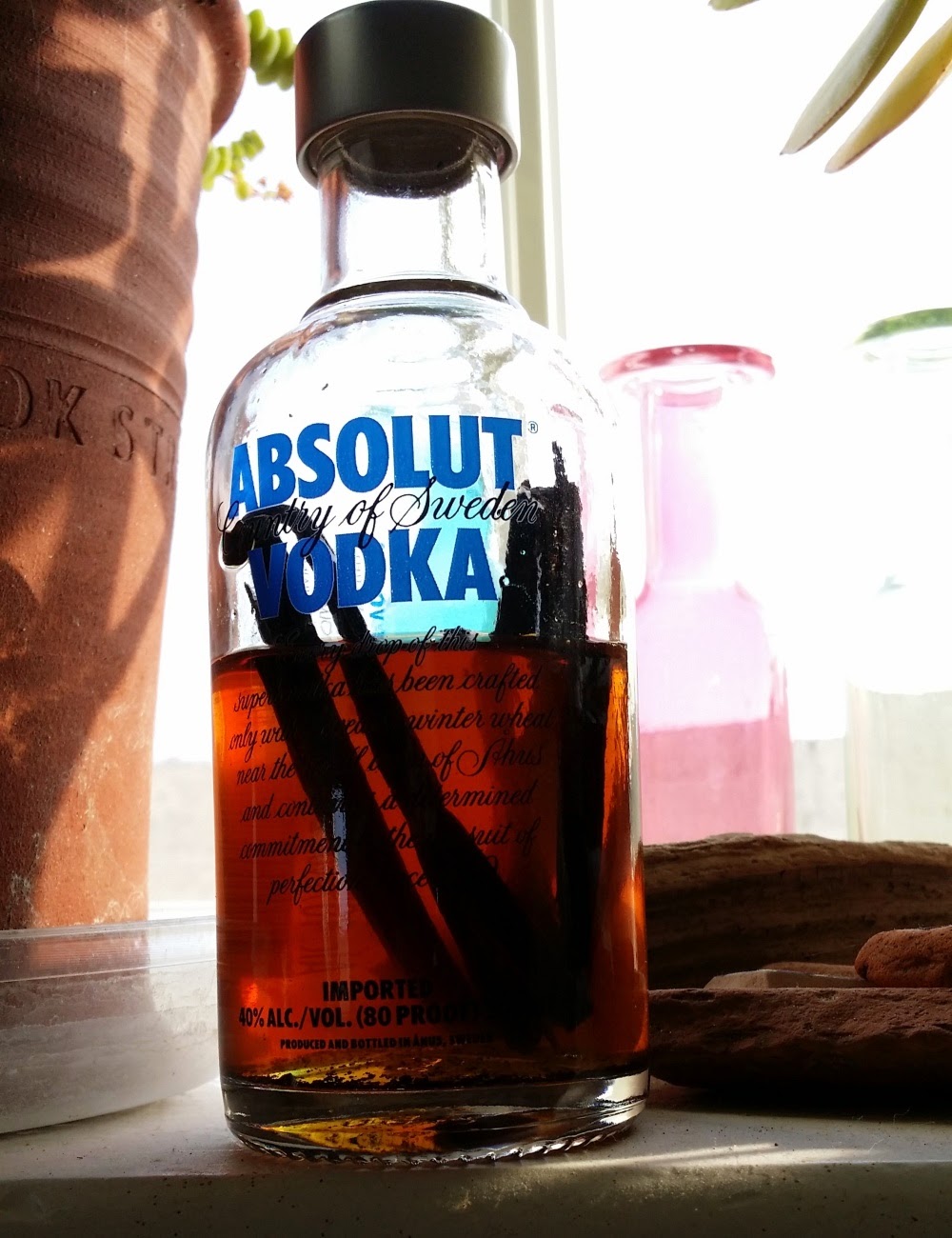
Absolut Vodka comes in a
nifty bottle to use.
I recently made my own. Here's my recipe --

200ml, or about 6.5 ounces, of Absolut brand vodka.

3 bourbon vanilla pods (the label will say they're grown in Madagascar)

Instructions:

How to split a vanilla pod
Split the pods lengthwise first. DO NOT scrape out the seeds.

Bend the pods in half before putting them into the vodka bottle.

Screw the top back on and store in a cool place in your kitchen. Leave for at least two weeks before using.

NEVER USE CHEAP OF FAKE VANILLA
That's it!

It should be strongly noted that the longer you let the beans cure, the stronger the vanilla flavor in the vodka and the richer the color. Just look at that whiskey color. It will darken the longer the beans cure.

Ideally, don't use it for the first two months. Then, instead of using the commercial stuff in your baking, use your own.

During the curing time, I checked on my beans, turning the bottle to circulate the flavors and help the seeds fall out of the pods. You can see them at the bottom of the bottle.

Leave the pods in the vodka. Don't take them out.

Before use, be sure to shake the bottle a little to get the seeds into your liquor for the signature vanilla speckled look in our cooking.

You can top of up the bottle with a little fresh vodka and occasionally add in a fresh bean and taking out an old one. Continuing to top up and add new beans creates a rich and flavorsome liquor that can be used in all of your baking, as well as a scent for homemade potpourri and perfume. And using extract from your initial batch means you can use the vanilla while it's curing, rather than having to start over when you've used the bottle completely.

And topping up means saving hundreds of dollars from buying commercial vanilla from the store.

And it's more affordable pure product than settling for 'cheap vanilla' which is flavored with synthetic vanillin which doesn't have any real vanilla in it.

So, now you know a little about vanilla...its history, its uses, and its mythology. And maybe now when you think of vanilla sex, you'll know it's not plain, uninteresting, and bland. In it's pure simplicity, vanilla is complicated and exotic, sultry and mysterious, subtly intoxicating and deeply sophisticated, erotic, and highly desirable.

Vanilla sex is complicated and exotic,
sultry and mysterious,
subtly intoxicating,
deeply sophisticated,
erotic and highly desirable.


Tuesday, February 28, 2012

Chicken Caesar Salad Wrap

Ya know, it's amazing what you can do with a few leftovers, and so few ingredients.

CHICKEN CAESAR SALAD WRAP

Leftover chicken breast (optionally: plain Quorn pieces dredged in Cajun seasoning {can do the same with the chicken if you want a spicier wrap}
Leftover romaine lettuce (iceberg will do in a pinch)
Leftover parmesan cheese (fresh grated right into the bowl preferred or why bother)
Leftover garlic and herb croutons
REAL Caesar dressing
A LITTLE mayo
Leftover flour tortilla wrap (the big ones)

Preparation
Chop the lettuce in thin strips and put into a bowl big enough for mixing in. Shred the leftover chicken breast (or Quorn) and add to the bowl. Finely grate the parmesan cheese over the top of the bowl Sprinkle in a few croutons. Pour on some dressing and a dollop of mayo and give it a good stir.

Let the mix sit for a moment to let the croutons have a chance to soak up some moisture. Add a little more dressing and mayo if you think it's too dry! I love extra parmesan.

While the salad is 'resting', put a wrap in the microwave for about 20 seconds, flipping midway through. You want it just warm enough that it becomes soft and doesn't crack when you make the wrap.

Assembly is easy. Put a big spoonful . . . go on, add a little more . . . to the center of the wrap. Fold in the edges, then roll from the edge closest to you. Don't be afraid to use your fingers to stuff in the salad as you go. You can always lick them off :-)

Put the wrap on a plate, fold side down, and slice diagonally if you want to impress your friends.

Voila! One Chicken (or Quorn) Caesar Salad Wrap.


And yes, lately, I'm all about the food!!!

Wednesday, June 23, 2010

Heart Shaped Scones

I keep saying I'm going to post a photo of my heart shaped scones and get sidetracked with other things. But I made scones last night and thought I better do it now or live forever with the nickname The Procrastinator! (said with a really bad Arnold accent)

These scones seem appropriate to me in so many ways. Firstly, every time I make them I'm reminded of my recently released book, A Piece of My Heart, and I have to wonder if Kate ever made these for Mick. I'm sure she has!

Also, and it can't be missed...heart shaped stones...scones. Get it? OK, that was lame, but it's cute. Admit it!!

But really, most of all, when I'm making scones I'm usually doing it for company or my dear husband. I'm rarely known for being overly traditional, so cutting the scone dough with a round cutter is just borrrring! And what better way to say 'I love you' to someone than with fresh, home baked scones shaped like hearts? They're something to share...take a big heart shaped scone and break it in two, sharing one side with your lover. And yes, having more than one between you is totally allowed! ;-)

Recently, some of my family came to Ireland for a visit. They arrived on American Mother's Day (Irish Mothering Day is exactly three Sundays before Easter Sunday). Because my cousin's mother-in-law was in the group and they arrived early in the morning, I decided to make a batch of heart shaped scones for their arrival to say, 'Welcome to Ireland, and happy Mother's Day!' Let me tell you. They went over so well I was making scones for breakfast every morning. But it was worth it to see the joy on everyone's faces.

OK, so you're asking for a recipe. I have to admit, I'm a lazy baker, and the Odlums company has made it SO easy for me to bake. They have a wonderful Quick line for making various breads, including scones. Simply dump the contents of the package into a bowl, add 250ml (1 cup) of milk, and mix. Don't over mix. I prefer plain scones, but dried fruit can be added into these very easily, and/or nuts. Whatever you like. This is a great basic scone and very adaptable.

When I do make home made scones, the Joy of Cooking website has a great recipe for Basic Scones.

One tip I must share about baking scones. If you're never sure if they're done, even if they've browned on top, is to use that little bit of dough left over after cutting them out as a timer. Roughly shape it into a slightly flattened round, something about the same height as the cut scones and place in the center of the cookie sheet. When your timer goes off, break open that leftover bit. If it's done inside, the scones are done. If it still feels tacky or looks undone, leave the scones in another couple of minutes. That's the best timer you'll ever need!

However you make your scones, be sure to serve them warm with clotted cream or real butter and homemade jam. Shown here is Ireland's own brand by Folláin's Blackberry Jam. Yum!!

Must mention Folláin jams. They're located in the country village of Ballvourney in West Cork, the village behind our property in the townland of Macroom. Folláin makes their james with 100% fruit, no preservatives, no added colorings, nothing artificial. It's pure fruit, some sugar and a lot of TLC. Folláin is actually the word for wholesome so they have a lot to live up to.

If you'll excuse me now, I'm going to pour myself a glass of milk and have one of these little lovelies!

Goile maith agat! (Irish for bon appétit...and you know what that means!)